AI Has Transformed PowerPoint
It used to be that AI produced awful PowerPoint presentations, or “decks,” as they’re known in business jargon. They were simplistic and contained very little substance. The visuals looked as though they had been created by a primary school student. AI could produce text well, but asking it to turn those thoughts into a professional presentation was a mistake
Then I noticed a dramatic improvement in the decks my team members were creating. After talking to them, I realized they were using AI. AI’s presentation-building capabilities had improved substantially. Obviously, I was thrilled that my team was independently finding ways to use AI to better serve our clients.
So I gave it another try.
The results were impressive. The presentations were substantive, detailed, visually appealing, and insightful.
And I realized that this has some interesting repercussions for the world of work, particularly for business executives and consultants.
AI Doesn’t Have To Give You Walls Of Text
Until recently, most of us interacted with AI through text. We asked a question and received several paragraphs in response.
If you’re a visual person, you can now ask AI to create an entire presentation for you. It doesn’t need to be a client deliverable or something intended for a formal business meeting. You can ask it to create a presentation specifically for you, designed around how you prefer to consume information.
That represents a extraordinary change in how we can use AI.
I’m surprised there hasn’t been more discussion about it. AI can now organize that information into a visual narrative, surface the key messages, and present them in a concise and actionable format. Given AI’s tendency to be excessively verbose, presentations impose a useful discipline. The slides need to be shorter, clearer, and more selective about what matters.
AI Rewards Poor Planning
I’m someone who usually needs to understand a project before I can delegate parts of it. Unfortunately, that often means that by the time I understand the project well enough to delegate it, there isn’t enough time left to do so.
Deck building is something I’ve historically preferred to delegate. It is time-consuming and demands pedanticism. Adjusting formatting, aligning objects, refining language, and reshaping the story can consume hours.
But delegation requires foresight. If I leave something too late, I can’t reasonably ask someone else to drop everything and build a presentation for me. Now I can create a solid deck myself in minutes.
Executives Should Become Analyzers, Not Presentation Makers
An extraordinary amount of a businessperson’s time goes into creating presentations.
There are endless reviews, revisions, discussions, and attempts to refine the message. The objective is often to decide how key content should be communicated – rather than what is being communicated.
AI makes that process dramatically faster.
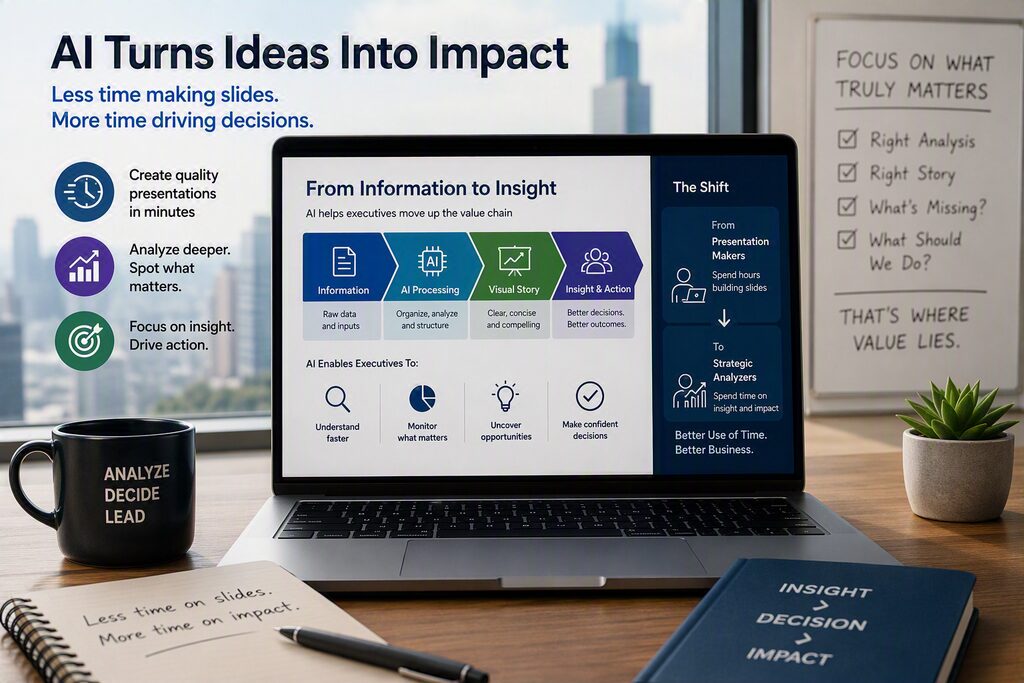
It enables executives to create presentations themselves without requiring several rounds of work with their teams. It also allows them to take information, including raw data, and turn it into something they can understand at a glance. That should change how executives spend their time.
Once AI can craft the message clearly and visually, more of an executive’s time can go into actual analysis. The valuable skill is now is deciding what information to analyze next, understanding what it means, and determining what action should follow.
I’m already seeing this shift in my own work.
This is being reinforced by AI’s ability to help us become better data scientists. AI has dramatically improved my ability to create Power BI dashboards. I’m already using it to build dashboards that help me monitor status, identify issues, and make decisions.
The capacity of an executive to analyze information is therefore being transformed by two related changes:
- AI can create quality presentations much faster.
- AI can help create new forms of ongoing data analysis.
Any business executive who currently spends a significant amount of time making PowerPoints needs to rapidly reconsider their skill set and what they do in a typical day.
Deck Building Is Becoming Less Valuable
These improvements have significant consequences for human teams. Deck building is a skill. Suddenly, that skill matters considerably less.
That is a tremendous benefit for people who need to communicate ideas but aren’t talented designers. It is a more worrying development for people whose primary professional value comes from building decks.
Those people will need to pivot.
I think back to my own time in consulting and the incredible amount of time that was spent iterating on presentations. Slides would go through review after review. Language would be adjusted. Shapes would be moved a few pixels. Entire workdays could disappear into changes that had a marginal effect on the quality of the final output.
To be clear, the presentations Copilot creates aren’t perfect. If I spent several hours building a deck myself, I could probably produce something better than AI, at least for now. But the additional hours would rarely justify the quality difference when AI can produce something useful in less than five minutes.
I can then spend a small amount of time correcting alignment, formatting, and other basic errors.
There will certainly be people who insist on spending many additional hours to obtain the final 10% of quality. In some limited situations, that might be justified. In many others, that perspective is skewed. People are wasting substantial resources because they remain attached to old ways of thinking and working.
Consulting Firms Can’t Keep Charging For The Old Process
For many consulting engagements, deck creation represents a substantial portion of the work. Enlightened clients will no longer want to pay for that in the same way.
If a consulting firm can substantially reduce the time required to build and revise a presentation, that efficiency should eventually be reflected in staffing and pricing. Firms that preserve large workforces and expensive engagement models simply because those structures worked in the past may be able to rely on momentum for a while, but eventually they will face consequences.
Similarly, executives purchasing consulting services should begin asking harder questions about engagements that primarily result in PowerPoint presentations.
- How much of the fee reflects genuine analysis?
- How much reflects presentation production?
- How much of that production work can now be completed by AI?
If AI has materially lowered the cost of producing the deliverable, clients should expect that reduction to be reflected in their bills.
For Now, AI Presentations Still Impress People
One consequence of the limited discussion around AI-generated presentations is that many people still don’t realize what AI can produce. When they see a good AI-generated deck, their minds are blown. They assume that someone spent hours creating it.
For the moment, this gives early users an advantage. People who know how to use these tools can produce work that appears unusually polished and sophisticated, often in a fraction of the time. That advantage will decline as awareness spreads.
People may eventually learn to identify AI-generated presentations. Some may dismiss them as “AI slop” and prioritize human-made decks simply because they are human-made. That would frequently be a waste of resources, but I wouldn’t put it past businesses to misallocate resources in that way.
Still, I think presentations will be harder to categorize than AI-generated text. PowerPoint contains more visual and artistic choices. A presentation created by Claude may look very different from one created by Copilot.
The Value Is Moving Up The Chain
What is changing is where the value lies. The value used to include the mechanical work of converting ideas into slides. Increasingly, AI can perform that work. The human contribution therefore needs to move up the chain.
The valuable questions are:
- Is the analysis correct?
- Are we telling the right story?
- What have we overlooked?
- What decision should we make?
AI can now turn our thoughts into slides. That means business executives need to spend less time arranging those thoughts attractively and more time ensuring that they are worth presenting in the first place.