Reading AI Can’t Lead People: Timeless Leadership Lessons for a Rapidly Changing World
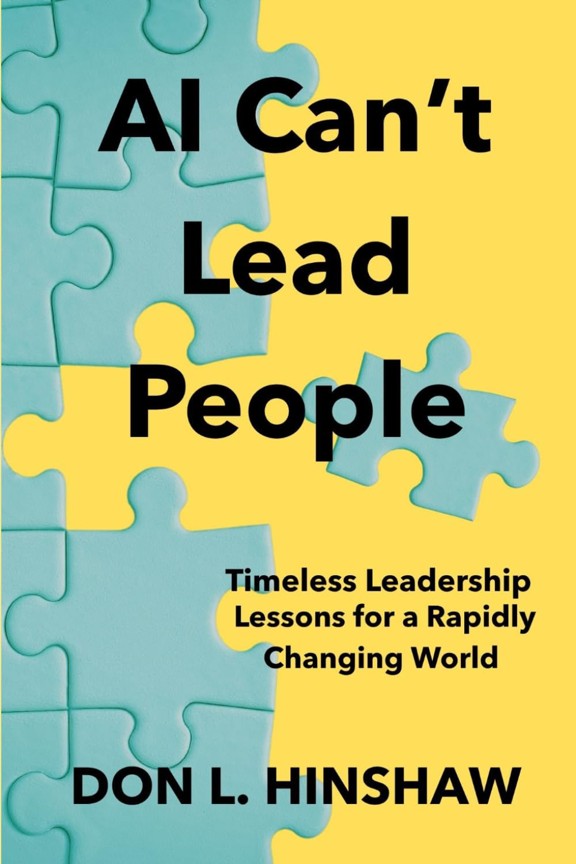
On the recommendation of a client who had worked with the author, Don L. Hinshaw, I picked up the book AI Can’t Lead People: Timeless Leadership Lessons for a Rapidly Changing World.
There Was Much I Learnt From And Liked About The Book
After reading the book I vowed to go back and review the pricing one of my clients is getting from its suppliers, looking, as Hinshaw would put it, “for gold”. I’m certain that we can negotiate better value than what we’re getting. I also committed myself to helping diversify that client’s suppliers so we aren’t so dependent on a small number of providers. More generally, I liked the idea of requiring CEO approval for any pricing increases from suppliers – it helps give team members who are actually talking to the suppliers an important negotiating lever.
Hinshaw wrote that companies that have frequent stock-outs typically also have too much inventory. That line made me pause because that’s exactly the problem that one of my clients is dealing with – both stock-outs of key SKUs and, in general, too much inventory. Reading that the two are so often linked was thought provoking.
The book also had a short but impactful playbook on what needs to be done immediately before and after a merger is announced. If I’m ever in a role where I have to help support or lead a merger, I’ll be reaching for the book to re-read that section.
The book featured the quote “what I’m seeing is drowning out what you’re saying” which I probably would never actually say to someone – it can come across as hostile and end discussion – but is certainly what I’ll likely be thinking in future circumstances. It articulates well a feeling I’ve had in the past.
There was much else that Hinshaw wrote that I agreed with. Laughter is the sign of a healthy workplace. There are no secrets – that is to say shortcuts – for achieving hard things in business. Industry experience is dramatically overrated – indeed it can actually be a hindrance when you’re looking to change how things are done. Customers are every department’s job – something that functions like Legal, Compliance, and HR often seem to forget.
But I Also Disagreed With Some Important Points
As I’ve written before, I know I’m disagreeing with people who have achieved much more than I have. Still disagreements help you figure out what you believe.
Pretty much everything I liked about the book was in the second half. Much of what was written in the first half didn’t quite resonate with me.
Outlining A Worthy Culture

Most importantly Hinshaw keeps returning to the importance of culture – which I agree with – but I found his prescriptions for what a good culture entails to be severely lacking. His very first point, for example, is that meetings must start on time. Which seems…very small.
Punctuality is no doubt important. Someone late to a meeting isn’t respecting the time of their colleagues. But I’ve never had much of a problem dealing with it. If a person shows up late, I tell them sternly and in front of everybody that it’s not okay and that they can’t disrespect their colleagues’ time in this way. Given that I’m rarely stern the message is delivered – not just to the tardy individual but also to everyone else in the meeting – and I don’t have a problem with lateness again.
If I entered an organization that emphasized being on time as a core part of its culture, I’d immediately dismiss not just that culture but also the seeming small-mindedness of the leadership that came up with it.
This post isn’t really about my organization’s culture, but I’d probably open with expecting curiosity. I want an organization that asks questions, tries out answers, makes mistakes, and then tries something different. (It’s not for nothing that this blog is called “Experiments”). This, to me, is the kind of idea that’s “worthy” of defining what an organization’s culture should be. Many of Hinshaw’s tenets of good culture sound like they belong in a high school classroom rather than in an organization looking to achieve impactful things.
No One Should Be Afraid Of Learning Something New
The book also mentions a few different times that it’s unacceptable for peers to correct their peers in front of their mutual boss. Though this seems to contradict an idea Hinshaw also keeps returning to: people shouldn’t be afraid to speak up. I agree with the latter prescription – which can be in conflict with the former. I don’t have an issue with a peer correcting another peer. Indeed I encourage it – if one person is making a mistake and the other person can see it I absolutely want the other person to speak up, and to be unafraid of doing so. They must, of course, do so constructively and respectfully.
My guess is that Hinshaw is afraid that the person who was corrected will come away humiliated, or fear what their boss will think of them. But to me that’s just the sign of a toxic work culture. In my organization I don’t want people to be afraid of being proven wrong. Another way of thinking about it is that they’re learning something new. It’s a good thing. And it starts from the very top. I’m often proven wrong by my team members and I’m proud to highlight it when that happens. As I’ve written before I want my organization to be one where my own floor is being raised rather than one where I’m the ceiling. I would want that culture to permeate my organization.
Who knows maybe the person wasn’t making a mistake after all. Maybe after the second person outlines the seeming mistake the first person explains that the second person has misunderstood. And that’s okay too, it means that the person who thought they had caught a mistake was actually the one who was making a mistake. And now they’ve learnt something new.
Leaders Can Send A Message By Subverting Expectations
Hinshaw writes about the importance of the leadership team sitting at the head of the table. I’ve often found it far more impactful to do the opposite and sit amongst the team members. It surprises everybody. They expect the leader to be at the head of the table and by not doing so the leader sends a clear message: the leader is willing and open to truly listen (something, it’s worth noting, Hinshaw mentions is important that leaders do). I don’t think it in any way diminishes the authority of the leader. Everyone knows who the CEO is, and they’re going to listen closely to what the CEO has to say no matter where they’re sitting. But by choosing not to sit at the head of the table it shows that the CEO encourages a two-way conversation.
Similarly Hinshaw writes about the importance of a leader providing coaching and mentoring. While he’s not wrong I wince at such terminology. It presupposes that the leader has all the answers. I typically try to frame what Hinshaw would probably call “mentoring” as “co-discovery”. I discuss what I think and the experiences that led me to think that way. I encourage the team member to share their thoughts and opinions. Typically I’ll actually invite them to speak first and then share my perspective adjusted to what they’re saying. Sometimes I’ll be the one who ends up learning something, because it turns out the person I was mentoring actually knew more about the subject than I did. It goes to something Hinshaw mentions in the book – you shouldn’t be afraid to hire people smarter than you.
Some Of The Solutions Can Be Problems…And Vice Versa

Hinshaw writes approvingly about his daughter getting out a customer’s order while in the ER because she’s just that focused on customer excellence. While the customer is, of course, paramount, that really just sounded to me like a poorly led organization. Customer satisfaction should not be dependent on a singular individual. Employees who can’t focus on recovering in the ER of all places probably neglect themselves in other important ways – which ultimately hurts both the organization and the customer.
The book also has a section on management directing a culture of giving back, indicating that this increases employee motivation. Having been in organizations where managers pushed causes onto me that I didn’t really believe in – but would feel obliged to contribute to – “motivation” isn’t really what I felt. I’m all for my team members using company resources to give back – but I let them come to me with proposals for what they would want that to look like, rather than something I push onto them.
Hinshaw opposes hiring family members. Yet, according to McKinsey, that family-owned businesses account for more than 70% of global GDP and about 60% of global employment suggests, at the very least, family involvement doesn’t have to be a hindrance to business success. And this isn’t just no-name mom and pop companies. Walmart, BMW, Koch, and Reliance are all luminaries of capitalism where family plays an important role.
I imagine Hinshaw is worried about all the political ramifications of having family members mixed in with non-family members in an organization. Again, it all comes down to effective leadership and culture. An organization where nonfamily members must be worried about crossing family members is an organization with a toxic culture. The problem then is the culture, not the presence of family members.
It’s A Good Read!
I’m glad I read it! I finished it in a single day. It’s always much easier to write about all that you disagreed with than what you agreed with. There’s really only one way to say “good job” but countless ways to critique.
I’ve only led organizations much smaller than the ones that Hinshaw is seemingly writing about. My disagreements may well be naïveté about what it requires to lead a large organization.
Come Monday, I’m going to make changes to my client’s business as a result of what I learned from this book. I don’t think there’s a better compliment that one can give to a book about business.