AI Will Drive A Rapid Evolution In Language
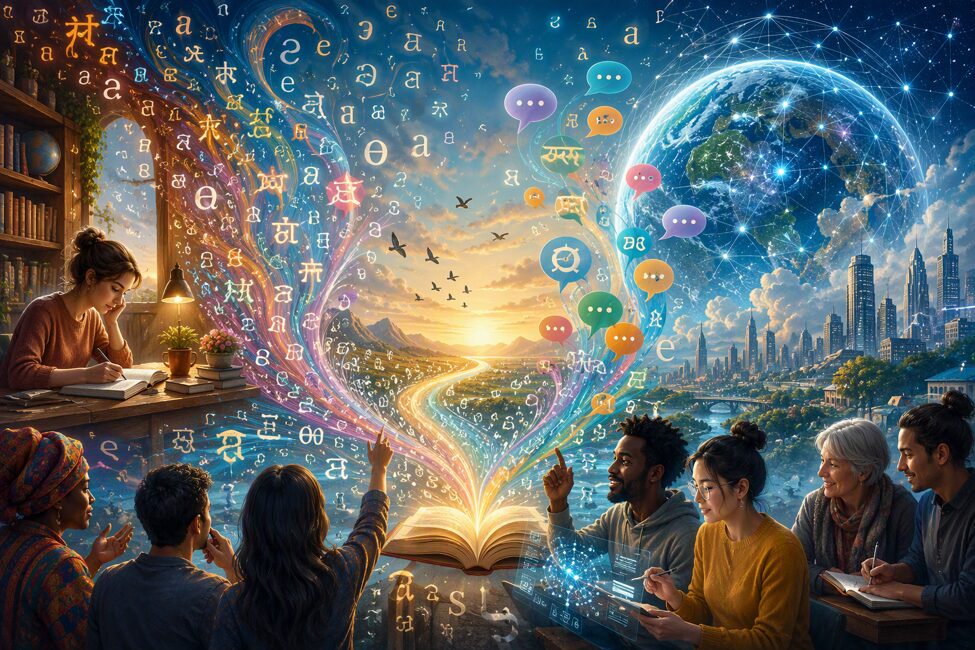
Language evolves. Could AI mean the end – or a dramatic slowing – of that evolution? After all, if AI starts doing most of the writing for us, perhaps we should expect a global “sameness” in language. Outside of asking AI systems to write like a pirate, the argument goes, language as it was when AI was invented is more or less how language will be going forwards as that’s what the AI systems were trained to produce.
In fact, I think the opposite will be true. I believe the advent of AI will mean language will evolve more quickly than before.
AI Will Usher In A Brand New World
In an essay for The Economist, Susan Schneider asks us to imagine a world where AI “hands us science that looks like magic”. There’s a sense of foreboding in how she describes it, but I envision such a world with excitement! I absolutely think AI is going to enable new inventions (scientific, cultural, economic and more) that are going to dramatically improve the world. Those inventions may seem magical at first – as new inventions often do – but with time and with further help from AI, we’ll understand the seeming magic and then work on propagating those discoveries.
This brand new – substantially improved – world will require new terminology and language to help explain and describe it all.
The sentence: “my phone uploaded the photos it took to the cloud” would seem nonsensical 30 years ago. We’re similarly going to see advancements that are going to require new language in the years ahead.
AI Will Spread Words Across Languages
Schadenfreude is a German word that means to take pleasure in someone else’s misery. English has no equivalent word, but because it’s a useful word, the German word has been adopted by English speakers.
It’s likely there are many such useful words hiding across the world’s languages – and with AI being the world’s best polyglot we finally have a system that can understand them all and pick out the words that other languages lack. I asked Copilot to come up with some examples and these are the ones I liked:
Tartle (Scots)
That awkward hesitation when you’re introducing someone because you’ve suddenly forgotten their name.
Aspaldiko (Basque)
Associated with meeting someone again after a very long absence and the pleasure of that reunion.
Cafuné (Brazilian Portuguese)
The affectionate act of gently running your fingers through someone’s hair.
Gigil (Tagalog)
That almost uncontrollable urge to squeeze or pinch something because it is overwhelmingly cute.
Age-otori (Japanese)
The unfortunate experience of looking worse after getting a haircut.
With AI we will hopefully see more of the world’s vocabulary enter the common vernacular.
Humans Will Become More Innovative In Their Use Of Language
As photographic technology spread and it became possible to faithfully recreate an image of our surroundings through a camera, painters started to create more abstract works. Their ability to make a replica of what they could observe was no longer as valued. This led to an exciting new era of art where we imagined beyond what we could see.
I similarly expect that writers will become more experimental in their use of language now that AI systems can, finally, write as well as humans. Rather than a threat human writers should treat this as liberation and a license to innovate.
For human writers, outside of just the pleasure of experimentation, doing so has a couple advantages that are immediately obvious. First, it will make it clear that the text isn’t AI. Just like we give additional value to artisanal things that are made by hand over those mass produced by machines, we’ll similarly add a premium to text that isn’t AI generated. Indeed, most of us already do. By using experimental language that an AI would never use, a writer will be able to make clear that it was written by them.
Second, and this may contradict my first point, but by having a signature style, it’ll be easier for the AI to write something in a particular author’s voice. I can imagine, for example, in a debate with a colleague, wanting to respond to an argument based on a post I’ve published on this blog, and asking an AI system to draft my response in my voice based on that blog post. By having a signature style of writing that the AI will be able to replicate, I’ll likely find it easier to paste in the AI response.
I have for decades been stubborn about mixing British, American, and Indian English. The British “learnt” is so much more phonetically pleasing than America’s “learned”. “Colour” without the “u” feels less colourful. But the British are wrong about “maths” – it should just be math. And Indians are onto something with prepone. I like to believe that my refusal to conform – even when it meant losing marks in exams or being quietly mocked through red underlines by Microsoft Office, or, according to one career advisor, being passed over for job opportunities due to the seeming misspellings on my resumé– will soon be seen as natural for those who enjoy writing.
Of course some of those experimental new approaches to language (by writers far more skilled than I) will receive widespread appreciation and will eventually be adopted as common grammatical norms learnt by all – including AIs.
I’m excited to see how language will evolve! Thanks to Sean and Fawaz for the conversation that helped me develop these views.